Apokalypsa (Apocalypse Now, 1979): Sestup do srdce temnoty
Apocalypse Now (1979): Descent into the Heart of Darkness
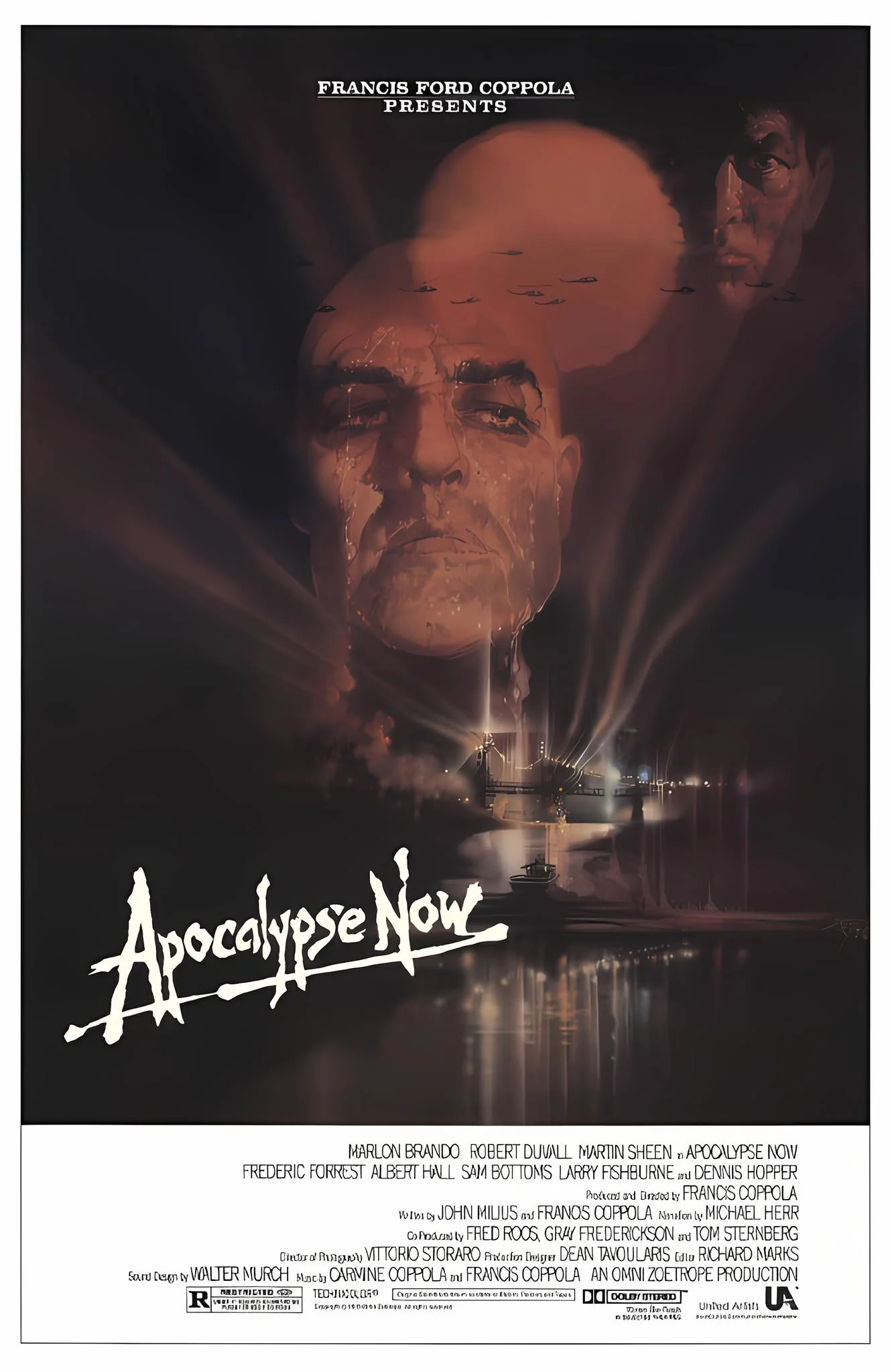
Analytická studie opusu magnum Francise Forda Coppoly zkoumající morální nihilismus, šerosvitnou kameru Vittoria Storara a zvukový design Waltera Murche.
An analytical study of Francis Ford Coppola's magnum opus exploring moral nihilism, Vittorio Storaro's chiaroscuro cinematography, and Walter Murch's sound design.
Tato studie dekonstruuje opus magnum Francise Forda Coppoly Apokalypsa (Apocalypse Now, 1979, stopáž 153 minut) jako vizuálně omamnou a filozoficky zdrcující adaptaci Conradova Srdce temnoty. Film transformuje vietnamský konflikt v surreálnou cestu proti proudu času a morálky.
Metodologicky se text zaměřuje na šerosvitnou kameru Vittoria Storara, revoluční zvukový design Waltera Murche a dekonstrukci postavy plukovníka Kurtze jako symbolu osvobozeného, leč destruktivního nihilismu. Snímek zkoumá hranici, kde se řád mění v chaos a kde se „hrůza“ stává jedinou objektivní pravdou.
I. Vizuální halucinace a estetika zkázy
Kameraman Vittorio Storaro vytvořil vizuální jazyk založený na kontrastu mezi umělým světlem (světlice, napalm) a hlubokým stínem džungle. Využití barevných dýmů a šerosvitu (chiaroscuro) v Kurtzově chrámu proměňuje realitu v mýtus.
Kamera zde nefunguje jako pouhý pozorovatel, ale jako aktivní účastník horečnatého snu. Storarova práce se světlem zrcadlí vnitřní stav kapitána Willarda – čím hlouběji v džungli, tím méně je světlo zdrojem bezpečí a tím více se stává nástrojem dezorientace.
II. Willard vs. Kurtz: Zrcadla šílenství
Cesta kapitána Willarda (Martin Sheen) je procesem zrcadlení. Willard není hrdina, ale „vrah poslaný zabít vraha“. Jeho cíl, plukovník Kurtz (Marlon Brando), představuje logické vyústění války: člověka, který odhodil pokrytectví vojenského řádu a přijal brutalitu jako čistou formu existence.
Kurtzova tragédie spočívá v jeho intelektuálním prozření – pochopil, že k vítězství je třeba „udělat z hrůzy přítele“. Willardova konečná konfrontace s Kurtzem není soubojem dobra se zlem, ale rituální obětí, která má ukončit Kurtzovo nesnesitelné vědomí pravdy.
III. Walter Murch a symfonie chaosu
Zvukový design Waltera Murche je pro film stejně klíčový jako obraz. Od úvodního vrtulníkového beatu splývajícího se stropním větrákem až po hudební dramaturgii celého díla, zvuk v Apokalypse definuje psychický prostor postav.
Murch využívá prostorový zvuk k navození pocitu totálního obklíčení. Ikonická sekvence s Wagnerovou Jízdou valkýr pak odhaluje absurditu války jako „velkolepého divadla“, kde je estetika nadřazena lidskému životu.
IV. Závěr: Hrůza jako poslední slovo
Závěrečný Kurtzův šepot „Ta hrůza… ta hrůza…“ (The horror…) není jen popisem válečných zvěrstev, ale metafyzickým konstatováním stavu lidské duše zbavené zábran. Coppola naznačuje, že civilizace je jen tenká slupka, která v extrémních podmínkách praská.
Willardův návrat z džungle zůstává otevřený a jeho nitro zůstává navždy infikováno Kurtzovým poznáním. Apokalypsa tak není filmem o válce ve Vietnamu, ale o věčné válce v člověku samotném.
Slovníček pojmů a bibliografie
- Šerosvit (Chiaroscuro) a vizuální halucinace: Vizuální stylizační metoda Vittoria Storara stavějící na ostrém kontrastu umělého světla a stínu, vytvářející mytickou a snovou atmosféru.
- Zrcadlení a rituální oběť: Narativní dynamika mezi Willardem a Kurtzem, kde likvidace cíle nefunguje jako morální vítězství, ale jako rituální osvobození ze stavu nesnesitelného poznání.
- Prostorový zvukový design: Zvuková koncepce Waltera Murche propojující reálné i stylizované zvuky (vrtulníky, větrák, Wagnerova hudba) s vnitřní psychologií postav.
- Metafyzická hrůza: Filozofické pojetí lidského stavu po stržení civilizační masky, v němž brutalita a chaos představují základní realitu existence.
Bibliografie (Chicago Style):
- Coppola, Francis Ford. Apocalypse Now: Redux (Screenplay). New York: Hyperion, 2001.
- Cowie, Peter. The Apocalypse Now Book. New York: Da Capo Press, 2001.
- Murch, Walter. In the Blink of an Eye: A Perspective on Film Editing. Beverly Hills: Silman-James Press, 2001.
- Storaro, Vittorio. Writing with Light. Tokyo: Shincho, 2002.
This study deconstructs Francis Ford Coppola’s magnum opus Apocalypse Now (1979, running time 153 minutes) as a visually intoxicating and philosophically devastating adaptation of Conrad’s Heart of Darkness. The film transforms the Vietnam conflict into a surreal journey against the current of time and morality.
Methodologically, the text focuses on Vittorio Storaro’s chiaroscuro cinematography, Walter Murch’s revolutionary sound design, and the deconstruction of Colonel Kurtz as a symbol of liberated yet destructive nihilism. The film explores the boundary where order turns to chaos and where “the horror” becomes the only objective truth.
I. Visual Hallucination and the Aesthetics of Doom
Cinematographer Vittorio Storaro created a visual language based on the contrast between artificial light (flares, napalm) and the deep shadow of the jungle. The use of colored smoke and chiaroscuro in Kurtz’s compound transforms reality into myth.
The camera does not function as a mere observer but as an active participant in a fever dream. Storaro’s work with light mirrors Captain Willard’s internal state—the deeper into the jungle, the less light serves as a source of safety, becoming instead a tool of disorientation.
II. Willard vs. Kurtz: Mirrors of Madness
Captain Willard’s (Martin Sheen) journey is a process of mirroring. Willard is not a hero, but an “assassin sent to kill an assassin.” His target, Colonel Kurtz (Marlon Brando), represents the logical culmination of war: a man who has discarded the hypocrisy of military order and embraced brutality as a pure form of existence.
Kurtz’s tragedy lies in his intellectual enlightenment—he understood that to win, one must “make a friend of horror.” Willard’s final confrontation with Kurtz is not a battle of good versus evil, but a ritual sacrifice intended to end Kurtz’s unbearable awareness of the truth.
III. Walter Murch and the Symphony of Chaos
Walter Murch’s sound design is as crucial to the film as its imagery. From the opening helicopter beat merging with a ceiling fan to the musical dramaturgy of the entire work, sound in Apocalypse Now defines the characters’ psychological space.
Murch utilizes spatial sound to induce a sense of total encirclement. The iconic Wagnerian air raid sequence (Ride of the Valkyries) reveals the absurdity of war as a “grand spectacle” where aesthetics are prioritized over human life.
IV. Conclusion: Horror as the Final Word
Kurtz’s final whisper, “The horror… the horror…”, is not merely a description of war atrocities but a metaphysical statement on the condition of the human soul stripped of restraints. Coppola suggests that civilization is only a thin veneer that cracks under extreme conditions.
Willard’s return from the jungle remains ambiguous—though he completed his mission, his inner self remains permanently infected by Kurtz’s realization. Apocalypse Now is thus not a film about the Vietnam War, but about the eternal war within man himself.
Glossary and Bibliography
- Chiaroscuro and Visual Hallucination: Vittorio Storaro’s cinematographic approach contrasting artificial light and deep shadow to evoke a surreal, mythic atmosphere.
- Mirroring and Ritual Sacrifice: The character dynamic between Willard and Kurtz where the elimination of the target becomes an act of ritual liberation rather than a moral victory.
- Spatial Sound Design: Walter Murch’s audio architecture blending diegetic sounds (helicopter blades, ceiling fan) and non-diegetic music to reflect psychological encirclement.
- Metaphysical Horror: The existential realization of human nature when stripped of societal norms, acknowledging chaos as a fundamental reality.
Bibliography (Chicago Style):
- Coppola, Francis Ford. Apocalypse Now: Redux (Screenplay). New York: Hyperion, 2001.
- Cowie, Peter. The Apocalypse Now Book. New York: Da Capo Press, 2001.
- Murch, Walter. In the Blink of an Eye: A Perspective on Film Editing. Beverly Hills: Silman-James Press, 2001.
- Storaro, Vittorio. Writing with Light. Tokyo: Shincho, 2002.