2001: Vesmírná odysea (1968): Evoluce vědomí
2001: A Space Odyssey (1968): Evolution of Consciousness
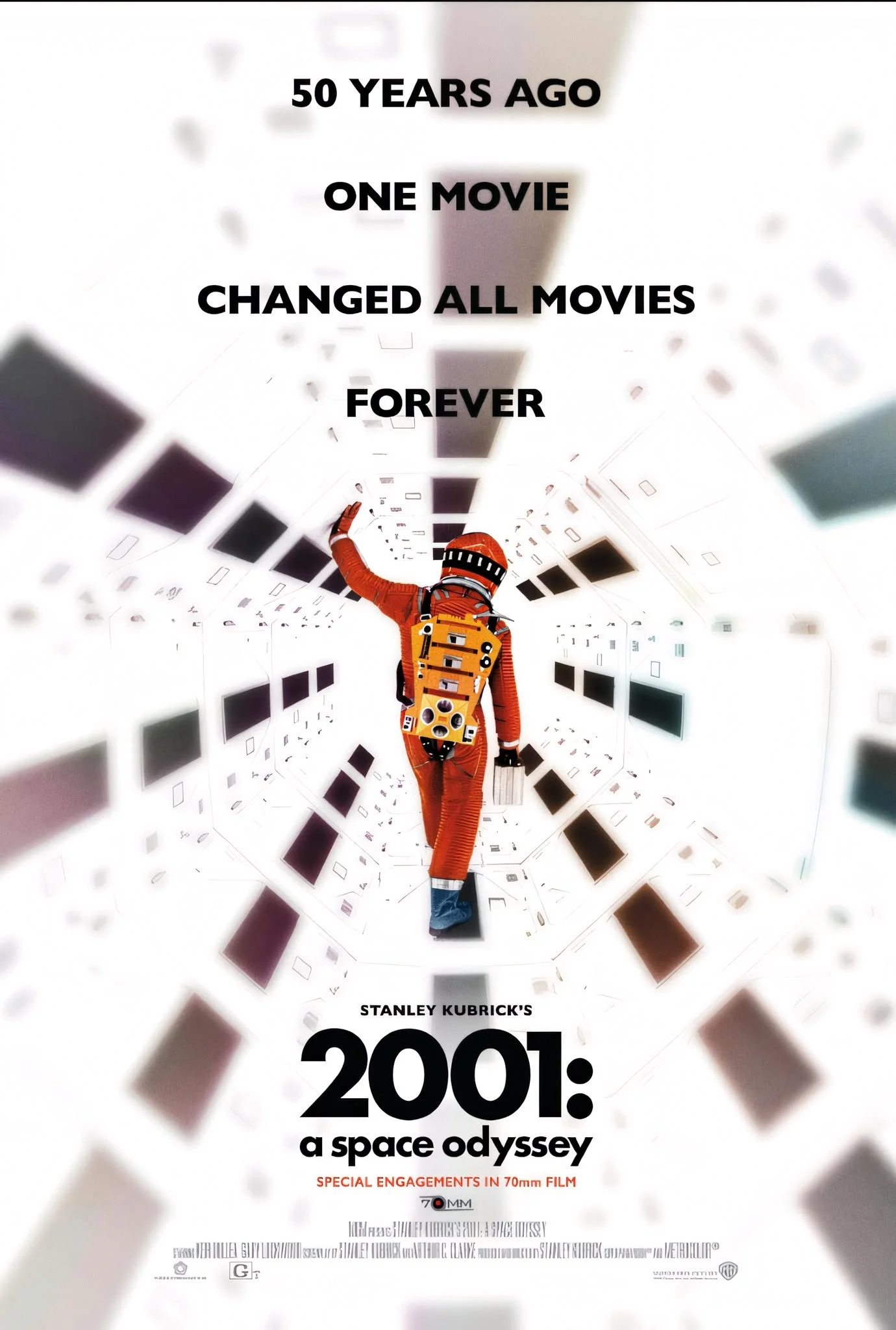
Analytická studie vizuální symfonie Stanleyho Kubricka zkoumající technologický transcendentalismus, motiv monolitu a tragédii umělé inteligence HAL 9000.
An analytical study of Stanley Kubrick's masterpiece exploring technological transcendentalism, the monolith motif, and the tragedy of HAL 9000.
Tato studie dekonstruuje film Stanleyho Kubricka 2001: Vesmírná odysea (1968, stopáž 149 minut) jako vizuální symfonii o lidském osudu. Snímek transformuje žánr science-fiction v nelineární filosofickou esej o vztahu mezi člověkem, nástrojem a neznámem.
Metodologicky se text zaměřuje na revoluční vizuální efekty Douglase Trumbulla, využití klasické hudby k vyjádření kosmického řádu a dekonstrukci postavy HAL 9000 jako zrcadla lidských emocí. Studie zkoumá motiv monolitu jako katalyzátoru evoluce – od prvního nástroje (zbraně) až po zrod Hvězdného dítěte (Star Child).
I. Vizuální symetrie a choreografie vesmíru
Kubrick a jeho kameraman Geoffrey Unsworth vytvořili vizuální jazyk založený na absolutní symetrii a čistotě. Film minimalizuje dialogy a sází na „kinetický prožitek“.
Využití valčíku Na krásném modrém Dunaji k choreografii pohybu vesmírných lodí definuje vesmír nikoliv jako nepřátelské vakuum, ale jako elegantní, matematicky uspořádaný prostor. Technická preciznost modelů a absence zvuku ve vakuu posunula realismus žánru na novou úroveň, zatímco psychedelická sekvence „Hvězdné brány“ předjímala hranice lidského vnímání.
II. Nástroj a zbraň: Od kosti k satelitu
Slavný střih (match cut), který spojuje kost vyhozenou do vzduchu lidoopem s orbitálním satelitem, je nejkomprimovanějším vyjádřením lidských dějin v kinematografii. Kubrick naznačuje, že celá lidská civilizace je definována schopností tvořit nástroje.
Monolit zde nefunguje jako bůh, ale jako učitel nebo „budík“, který lidstvo popostrčí k dalšímu evolučnímu skoku v okamžiku, kdy jeho stávající technologie (včetně HAL 9000) narazí na své limity.
III. HAL 9000: Tragédie dokonalého stroje
Superpočítač HAL 9000 je paradoxně nejlidštější postavou filmu. Jeho selhání není důsledkem technické chyby, ale psychologického konfliktu (lži, kterou mu lidé nařídili).
HALova smrt, doprovázená regresem k jeho „dětství“ a zpěvem písně Daisy Bell, představuje hluboký melancholický moment. Střet mezi astronauty a HALem je soubojem tvůrce se svým dokonalým obrazem, který jej nakonec musí zahubit, aby se tvůrce mohl vyvíjet dál.
IV. Závěr: Návrat k nevinnosti (Star Child)
Závěrečná kapitola v neoklasicistním pokoji, kde čas ztrácí lineární smysl, je obrazem biologické i spirituální transformace. David Bowman (Keir Dullea) zde prochází procesem stárnutí a smrti, aby byl znovu zrozen jako Star Child.
Tento závěr není koncem, ale novým počátkem – překonáním lidské schránky a návratem k čistému vědomí, které shlíží na Zemi. Kubrick tak uzavírá kruh od úsvitu lidstva k jeho kosmickému vykoupení.
Slovníček pojmů a bibliografie
- Střihová asociace (Match Cut): Přechodový kamerový střih propojující dva vizuálně podobné objekty (kost a satelit), stlačující tisíciletí lidské evoluce do jediného políčka filmu.
- Technologický transcendentalismus: Filosofický koncept, v němž lidstvo překračuje své biologické limity skrze vývoj nástrojů, technologií a následnou transformaci vědomí.
- Psychologický paradox umělé inteligence: Narativní stav, kdy se syntetická bytost (HAL 9000) pod tlakem lidského klamu stává zranitelnější a emotivnější než chladně racionální lidští členové posádky.
- Hvězdné dítě (Star Child): Symbol neotenického znovuzrození a transhumanistické evoluční fáze lidstva po překonání fyzické existence.
Bibliografie (Chicago Style):
- Agel, Jerome. The Making of Kubrick’s 2001. New York: New American Library, 1970.
- Chion, Michel. Kubrick’s Cinema Odyssey. London: British Film Institute, 2001.
- Clarke, Arthur C. 2001: A Space Odyssey. London: Hutchinson, 1968.
- Walker, Alexander. Stanley Kubrick, Director. New York: Norton, 1999.
This study deconstructs Stanley Kubrick’s 2001: A Space Odyssey (1968, running time 149 minutes) as a visual symphony of human destiny. The film transforms the science-fiction genre into a non-linear philosophical essay on the relationship between man, tool, and the unknown.
Methodologically, the text focuses on Douglas Trumbull’s revolutionary visual effects, the use of classical music to express cosmic order, and the deconstruction of HAL 9000 as a mirror of human emotions. The study examines the monolith as a catalyst for evolution—from the first tool (weapon) to the birth of the Star Child.
I. Visual Symmetry and Cosmic Choreography
Kubrick and cinematographer Geoffrey Unsworth created a visual language based on absolute symmetry and purity. The film minimizes dialogue, relying on a “kinetic experience.”
The use of The Blue Danube waltz to choreograph the movement of spacecraft defines space not as a hostile vacuum, but as an elegant, mathematically ordered realm. The technical precision of the models and the absence of sound in a vacuum pushed the genre’s realism to a new level, while the psychedelic “Stargate” sequence anticipated the limits of human perception.
II. Tool and Weapon: From Bone to Satellite
The famous match cut, linking a bone thrown into the air by an ape to an orbiting satellite, is the most compressed expression of human history in cinema. Kubrick suggests that all human civilization is defined by the ability to create tools.
The monolith does not function as a god here, but as a teacher or “alarm clock” that nudges humanity toward its next evolutionary leap the moment its current technology (including HAL 9000) reaches its limits.
III. HAL 9000: The Tragedy of the Perfect Machine
The supercomputer HAL 9000 is, paradoxically, the film’s most human character. Its failure is not due to a technical glitch but a psychological conflict (the lie humans ordered it to maintain).
HAL’s death, accompanied by a regression to its “childhood” and the singing of Daisy Bell, represents a profound melancholic moment. The clash between the astronauts and HAL is a battle between the creator and his perfect image, which the creator must ultimately destroy in order to continue evolving.
IV. Conclusion: Return to Innocence (The Star Child)
The final chapter in the neoclassical room, where time loses linear meaning, is an image of biological and spiritual transformation. David Bowman (Keir Dullea) undergoes the process of aging and death only to be reborn as the Star Child.
This conclusion is not an end but a new beginning—the transcendence of the human shell and a return to pure consciousness gazing upon the Earth. Kubrick thus closes the circle from the dawn of humanity to its cosmic redemption.
Glossary and Bibliography
- Match Cut & Evolutionary Jump: A cinematic editing technique connecting two visually similar objects (bone and satellite), compressing millennia of human technological progress into a single frame transition.
- Technological Transcendentalism: A philosophical concept wherein humanity transcends biological limitations through toolmaking, technology, and subsequent consciousness expansion.
- AI Psychological Paradox: A narrative device where a synthetic entity (HAL 9000) becomes more fragile and emotionally expressive than its stoic human creators under the weight of systemic deception.
- Star Child & Transcendence: A symbol of evolutionary rebirth and transhumanist advancement following the abandonment of mortal physical form.
Bibliography (Chicago Style):
- Agel, Jerome. The Making of Kubrick’s 2001. New York: New American Library, 1970.
- Chion, Michel. Kubrick’s Cinema Odyssey. London: British Film Institute, 2001.
- Clarke, Arthur C. 2001: A Space Odyssey. London: Hutchinson, 1968.
- Walker, Alexander. Stanley Kubrick, Director. New York: Norton, 1999.