Ministry of Fear (1944): Paranoia jako kognitivní lucidita ve válečném stavu
Ministry of Fear (1944): Paranoia as Cognitive Lucidity in Wartime Modernity
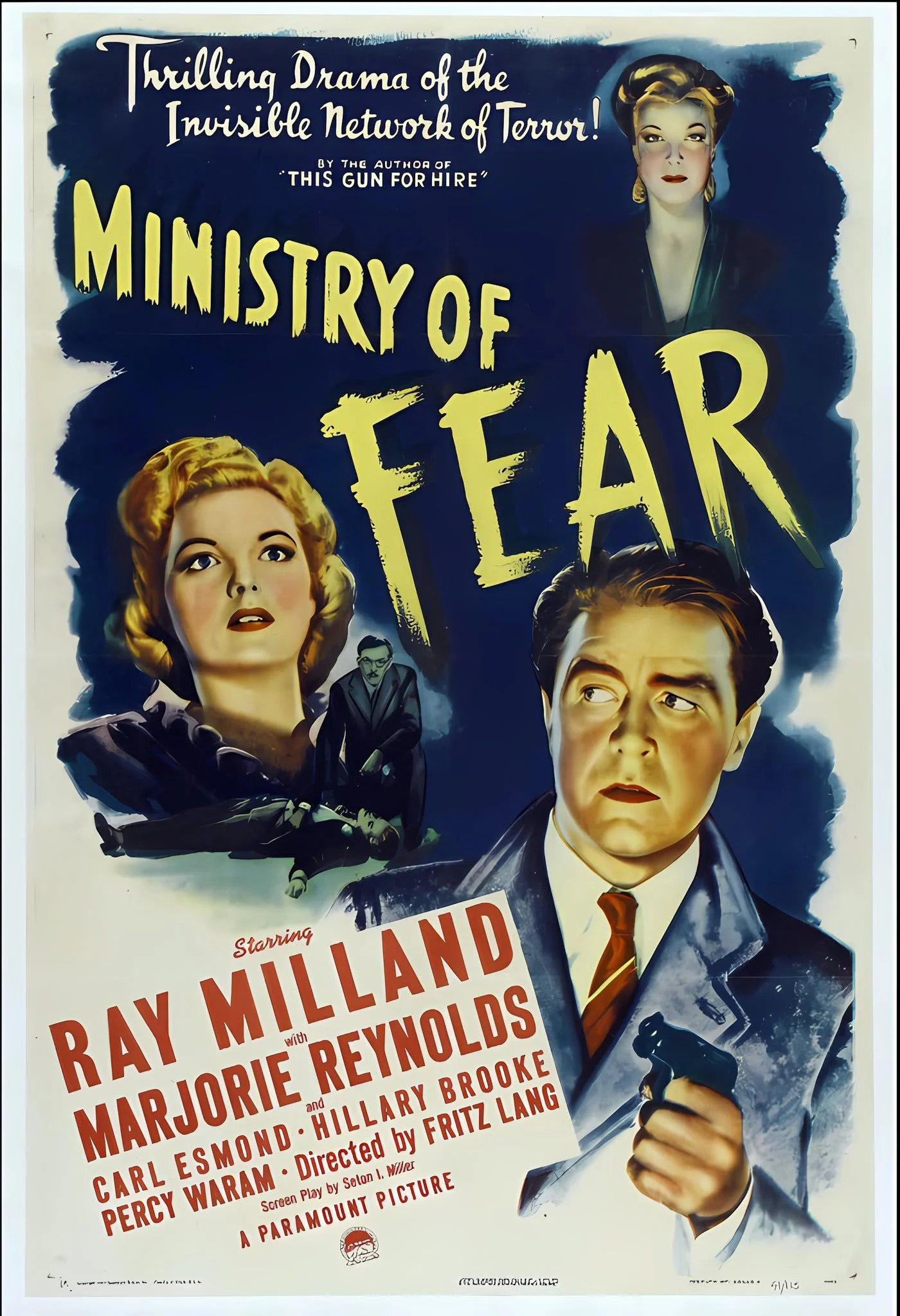
Analytická studie válečného noiru Fritze Langa zkoumající paranoiu jako epistemologickou luciditu, kulturu ambientního dohledu a geometrii podezření v Londýně za války.
Analytical study of Fritz Lang's wartime noir exploring paranoia as epistemological lucidity, surveillance culture, and the aesthetics of scarcity.
Snímek Ministry of Fear (Ministerstvo strachu, 1944, stopáž 87 minut) z produkce studia Paramount v režii Fritze Langa představuje paradigmatický válečný noir, v němž paranoia nevystupuje jako psychická anomálie či patologie, nýbrž jako jediný epistemologicky adekvátní způsob vnímání reality. Lang transformuje konvence špionážního thrilleru v hlubokou alegorii moderní společnosti dohledu.
V podmínkách válečné materiální nouze, za využití přísné chiaroscuro kamery Henryho Sharpa a zhuštěného narativu konstruuje Lang geometrii všeobecného podezření, v níž se samotná viditelnost stává smrtící pastí[cite: 105].
I. Produkční rámec a adaptace Grahama Greena
Film adaptuje stejnojmenný román Grahama Greena z roku 1943, jejž autor sám označil za pouhé „entertainment“ (zábavné čtení)[cite: 105]:
- Institucionální mantinely studia Paramount: Scénář a produkci vedl Seton I. Miller[cite: 105]. Archivní materiály dokládají, že Lang vedl se studiem permanentní boj o autorskou kontrolu[cite: 105]. Zatímco Miller usiloval o konvenční protinacistickou detektivku, Lang materiál radikálně zhustil a převedl jej do roviny existenciální noční můry[cite: 105].
- Estetika nouze jako tvůrčí metoda: Přísné rozpočtové limity válečného Hollywoodu Lang proměnil ve formální devízu[cite: 105]. Absence velkolepých exteriérů si vynutila stísněné studiové dekorace, které umocnily pocit neprodyšné prostorové pasti[cite: 105].
II. Banalita zla a iniciační past s koláčem
Zápletka je odpálena zdánlivě absurdním, triviálním incidentem na venkovské charitativní pouti[cite: 105]:
- Náhodný zisk mikrofilmu: Stephen Neale (Ray Milland), čerstvě propuštěný z ústavu pro choromyslné po dvouleté internaci za asistovanou sebevraždu své nevyléčitelně nemocné ženy, vyhraje v soutěži koláč, v němž je ukryt nacistický mikrofilm se strategickými plány britské obrany[cite: 105].
- Arendtovská banalita aparátu: Spiknutí se neprojevuje dramatickými gesty; operuje skrze dobročinné bazary, věštkyně v maringotkách, zdvořilé krejčí a úřední spolky[cite: 105]. Zlo se schovává za fasádou ctihodnosti britského měšťanstva. Stephenova zkušenost z psychiatrické léčebny mu dává klíčovou výhodu: je zvyklý na to, že svět nedává smysl, a jeho podezřívavost jej chrání před naivitou zdravé většiny[cite: 105].
III. Vizuální geometrie Henryho Sharpa: Temný Londýn jako stav mysli
Kameraman Henry Sharp vytvořil jeden z nejradikálnějších vizuálních konceptů válečného noiru[cite: 105]:
- Zatemnění jako ontologie: Válečný blackout v bombardovaném Londýně nepředstavuje pouhou historickou kulisu; je to permanentní psychický stav[cite: 105]. Zdroje světla jsou vzácné – kapesní svítilny prořezávající mlhu, zápalky a blesky explozí[cite: 105].
- Klaustrofobické diagonály: Schodiště, slepé chodby a okna fungují jako vizuální mříže[cite: 105]. Slavná scéna spiritistické seance, v níž dojde k vraždě ve tmě za doprovodu tikotu hodin a střelby z revolveru, dokonale demonstruje nemožnost ověřit pravdu skrze zrakový vjem.
IV. Paranoia jako kognitivní lucidita
Ústřední teoretický přínos filmu spočívá v totálním převrácení diagnostického chápání paranoie[cite: 105]:
- Šílenství jako zdravý rozum: Stephen Neale je okolím systematicky zpochybňován jako labilní blázen trpící stihomamem[cite: 105]. Film však divákovi krok za krokem dokazuje, že každé jeho zdánlivě absurdní podezření je zcela pravdivé[cite: 105].
- Adaptace na moderní svět: V podmínkách totální války a všudypřítomné špionáže není důvěřivost ctností, nýbrž fatální slabostí. Paranoia v Langově podání představuje jediný funkční kognitivní nástroj přežití v byrokratickém labyrintu moderního státu[cite: 105].
V. Závěr: Rozptýlený dohled a memento podezření
Závěrečná přestřelka na střeše domu v dešti stvrzuje zánik špionážní sítě, nikoliv však zánik paranoie[cite: 105]:
- Systém bez centra: Titulní „Ministerstvo strachu“ nemá konkrétní budovu ani úřední adresu[cite: 105]. Je to amorfní síť strachu, která prostupuje celou společnost skrze poštu, knihy a telefony[cite: 105].
- Odkaz: Ministry of Fear zůstává mistrovskou ukázkou toho, jak Fritz Lang dokázal v žánrovém studiovém filmu analyzovat hluboké existenciální a politické otázky moderního věku[cite: 105]. Ukazuje svět, v němž je hranice mezi příčetností a šílenstvím definována výhradně tím, kdo má v rukou kontrolu nad informacemi[cite: 105].
Slovníček pojmů a bibliografie
- Kognitivní lucidita paranoie: Stav, kdy extrémní podezřívavost jedince nepředstavuje duševní poruchu, nýbrž racionální a přesné pochopení reality v prostředí všeobecného spiknutí[cite: 105].
- Válečný blackout (Zatemnění): Opatření proti leteckému bombardování zakazující noční svícení, přetavené ve filmu noir v metaforu epistemologické nejistoty a morální temnoty[cite: 105].
- Ambientní dohled: Rozptýlená forma kontroly a sledování, která nevychází z jednoho ústředního bodu, nýbrž je zabudována do všedních vztahů a institucí společnosti[cite: 105].
Bibliografie (Chicago Style):
- Eisner, Lotte H. The Haunted Screen: Expressionism in the German Cinema and the Influence of Max Reinhardt. Berkeley: University of California Press, 1969[cite: 105].
- Greene, Graham. The Ministry of Fear. London: Heinemann, 1943[cite: 105].
- Gunning, Tom. The Films of Fritz Lang: Allegories of Vision and Modernity. London: British Film Institute, 2000[cite: 105].
- Kracauer, Siegfried. From Caligari to Hitler: A Psychological History of the German Film. Princeton: Princeton University Press, 1947[cite: 105].
Ministry of Fear (87 min), produced by Paramount Pictures and directed by émigré filmmaker Fritz Lang, stands as a paradigmatic wartime noir in which paranoia emerges not as pathology but as an epistemologically justified mode of perception. The film transforms the conventions of the espionage thriller into an allegory of modern surveillance culture. Through constrained production conditions, chiaroscuro cinematography by Henry Sharp, and narrative condensation, Lang constructs a geometry of suspicion in which visibility itself becomes unstable.
I. Production Context and Institutional Constraint
Released in 1944, the film adapts the 1943 novel by Graham Greene, who classified the book as an “entertainment”. The cinematic version significantly condenses and restructures Greene’s narrative, foregrounding psychological paranoia over political ambiguity.
The production occurred under wartime austerity. Lang worked within a tightly scheduled studio framework and with a screenplay credited to Seton I. Miller. Archival documentation indicates that Lang’s contractual position limited his authority over script revisions. Rather than full authorial control, the film reflects a negotiation between studio dramaturgy and Lang’s directorial grammar. Constraint becomes formal strategy.
II. Aesthetics of Scarcity: The Geometry of Shadows
The visual design relies on severe contrasts of light and darkness. In collaboration with Sharp, Lang deploys high-contrast lighting not merely for atmosphere but as structural epistemology. The blackout London of the film is less a geographic space than an ontological condition.
Interiors dominate: corridors narrow perception, staircases fragment orientation, and windows become ambiguous apertures acting simultaneously as sources of illumination and vectors of exposure. Spatial compression intensifies narrative determinism. Within its 87-minute runtime, the city transforms into a closed system where surveillance is ambient rather than centralized. The mise-en-scène anticipates noir configurations in films like Double Indemnity and The Woman in the Window, while displacing paranoia from the private erotic sphere into the geopolitical.
III. Narrative Mechanism: The Trap as System
The plot is triggered by an apparently trivial event: Stephen Neale (Ray Milland), recently released from an asylum, wins a cake containing microfilm at a charity fair. Accident replaces intention; chance reveals conspiracy.
This banal inciting incident exemplifies what later political philosophy—most notably Hannah Arendt—conceptualized as the “banality of evil,” where evil operates through ordinary procedures, polite gestures, and institutional routines. Neale’s former psychiatric confinement assumes allegorical proportions: the character occupies a liminal epistemic position where he perceives danger accurately, yet his credibility is structurally compromised. Suspicion becomes the only rational mode of survival. Meanwhile, Carla Hilfe (Marjorie Reynolds) serves as a counterweight to systemic paranoia, representing provisional trust within generalized distrust.
IV. Exile, Modernity, and Surveillance
Lang’s status as an émigré from Nazi Germany inflects the film’s thematic architecture. The atmosphere of invisible infiltration recalls European anxieties analyzed by Siegfried Kracauer and Lotte Eisner. Expressionist legacies persist through perceptual instability—the camera rarely grants full spatial mastery and withholds certainty.
The Ministry itself functions as an abstraction; bureaucracy becomes spectral, and authority is omnipresent yet indistinct. The result is a proto-Foucauldian topology of dispersed power, where control operates through informational asymmetry rather than visible tyranny.
V. Paranoia as Rational Cognition
The central thesis of this study is that paranoia in Ministry of Fear is not deviance but lucidity. Although Neale’s mental history marks him as socially unstable, the film systematically validates his suspicion, as every moment of doubt corresponds to an actual threat. Lang inverts diagnostic logic: madness becomes methodological clarity within a deceptive system and a cognitive adaptation to total war modernity.
VI. Conclusion: Formal Economy and Analytic Vigilance
The film’s brevity intensifies narrative velocity, stripping scenes to functional essentials and eliminating psychological exposition through transitional ellipses. Through spatial compression, chiaroscuro epistemology, and narrative determinism, Lang constructs a cinematic machine where visibility and vulnerability coincide. Paranoia is presented not as illness but as analytic vigilance—in the twentieth century’s bureaucratic labyrinths, lucidity appears indistinguishable from madness.
Glossary and Bibliography
- Chiaroscuro Epistemology: The deployment of sharp light and shadow contrasts as a narrative and cognitive instrument, defining the boundaries of exposure and truth within the film frame.
- Ambient Surveillance: A dispersed, pervasive system of control and monitoring that operates not from a single centralized hub, but from within the fabric of the everyday environment.
- Epistemic Liminality: The structural condition of a character whose credibility or psychological stability is doubted (e.g., asylum background), paradoxically granting them clear insight into systemic dangers.
- Banality of Evil: The concept (later theorized by Hannah Arendt) describing how atrocities and systemic threats operate through routine administrative procedures, politeness, and everyday institutional habits.
Bibliography (Chicago Style):
- Arendt, Hannah. Eichmann in Jerusalem: A Report on the Banality of Evil. New York: Viking Press, 1963.
- Eisner, Lotte H. The Haunted Screen: Expressionism in the German Cinema and the Influence of Max Reinhardt. Berkeley: University of California Press, 1969.
- Greene, Graham. The Ministry of Fear. London: Heinemann, 1943.
- Gunning, Tom. The Films of Fritz Lang: Allegories of Vision and Modernity. London: British Film Institute, 2000.
- Kracauer, Siegfried. From Caligari to Hitler: A Psychological History of the German Film. Princeton: Princeton University Press, 1947.